"For almost two years now, very few people have known that I built an entire new service category in my business around helping people feel cared for, and I never told anyone that I started it because I was the one who needed care first."
I want to take you back to before the head spa existed — before the suites, before the ritual, before any of it. The Bronze Lily was already here, and so was I, working face-to-face with clients every day. In early 2022, a spot showed up in the center of my throat. It was a little smaller than a dime, light pink at first, and it would itch, flare red, calm down, and come back again. It never got bigger. It was just annoying — the kind of thing you ignore for months. After enough rounds of it appearing and disappearing, a couple of people in my life said the same thing: go see a dermatologist.
I have never spent so little time in a doctor's office. I walked in, filled out the paperwork, got taken straight back, and the dermatologist looked at my throat for maybe two seconds. Eczema, essentially — "it'll clear up easily." Three little sample tubes, a prescription to fill when those ran out, have a nice day. I was out the door in under twenty minutes. The cream was clobetasol propionate 0.05%. I didn't know then that it's a "super-high-potency" topical steroid — the strongest class made. I just knew it worked. A little dab and the spot cleared in days. A week or so later it came back, so I used it again. When the samples ran out, I filled the full-size tube. Apply, clear, come back, repeat.
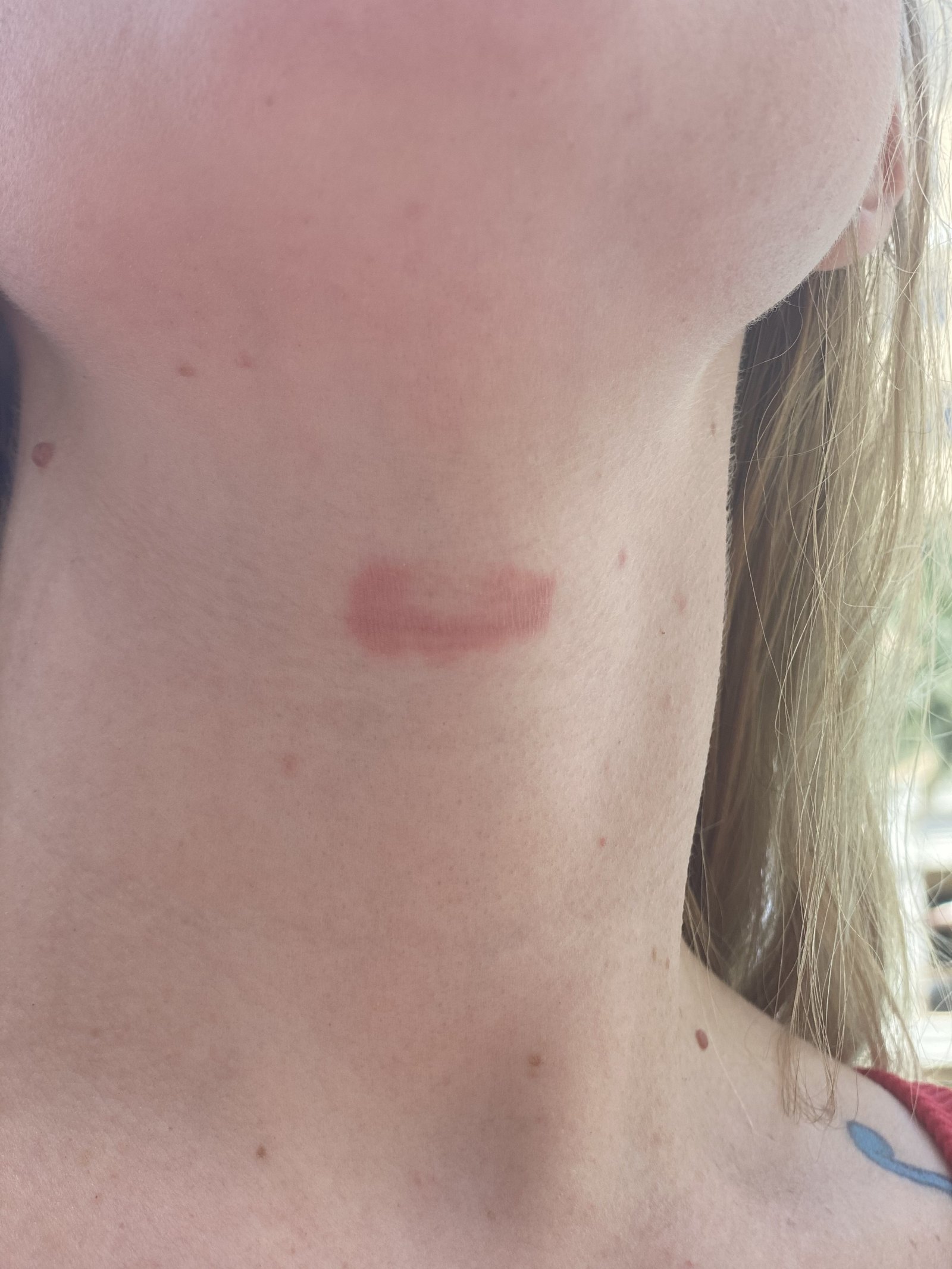 Early 2022 · the original spot
Early 2022 · the original spot on my throat, a little smaller than a dime. This is where all of it started.
When stopping made it worse
About six months into that prescription tube, I had my first flicker of doubt. Hmm — it seems worse when I don't use it. Am I going to need this cream for the rest of my life? The thought was faint and fleeting, and work and daily life made it easy to push away. So I kept using it. By the time almost a year had passed since that first spot, the "spot" wasn't a spot anymore. I was putting the cream on my throat and neck, around my mouth, on my chin under my bottom lip, around my nose, between my eyebrows and in them, in front of my ears, and along the hairline of my scalp. Everywhere the cream had been, the eczema kept coming back — and angrier every time. Red. Itchy. Burning. Flaking.
Then came the night I'll never forget. My tube was empty and the spots were screaming, so I cut the metal tube open with scissors to scrape out what was left — while texting a client of mine who's a nurse practitioner, asking her to call a refill in to CVS. I was so panicked she'd get the wrong cream that I looked it up online and sent her a photo of the tube to make sure. And somewhere in the middle of all that — scraping a cut-open tube at midnight, feeling like an addict, which by then is exactly what my skin had become — my gut finally said it out loud: google this cream. A documentary came up in the results, and I watched the whole thing that night. There's a moment in it where the narrator describes the realization almost everyone in the TSW community eventually has — I did this to myself, with this cream — and that's what hit me, sitting there in the dark. I cried for a good hour. Then I made the only decision that ever made sense to me: I stopped. That night. Cold turkey. The refill my client called in? I never picked it up.
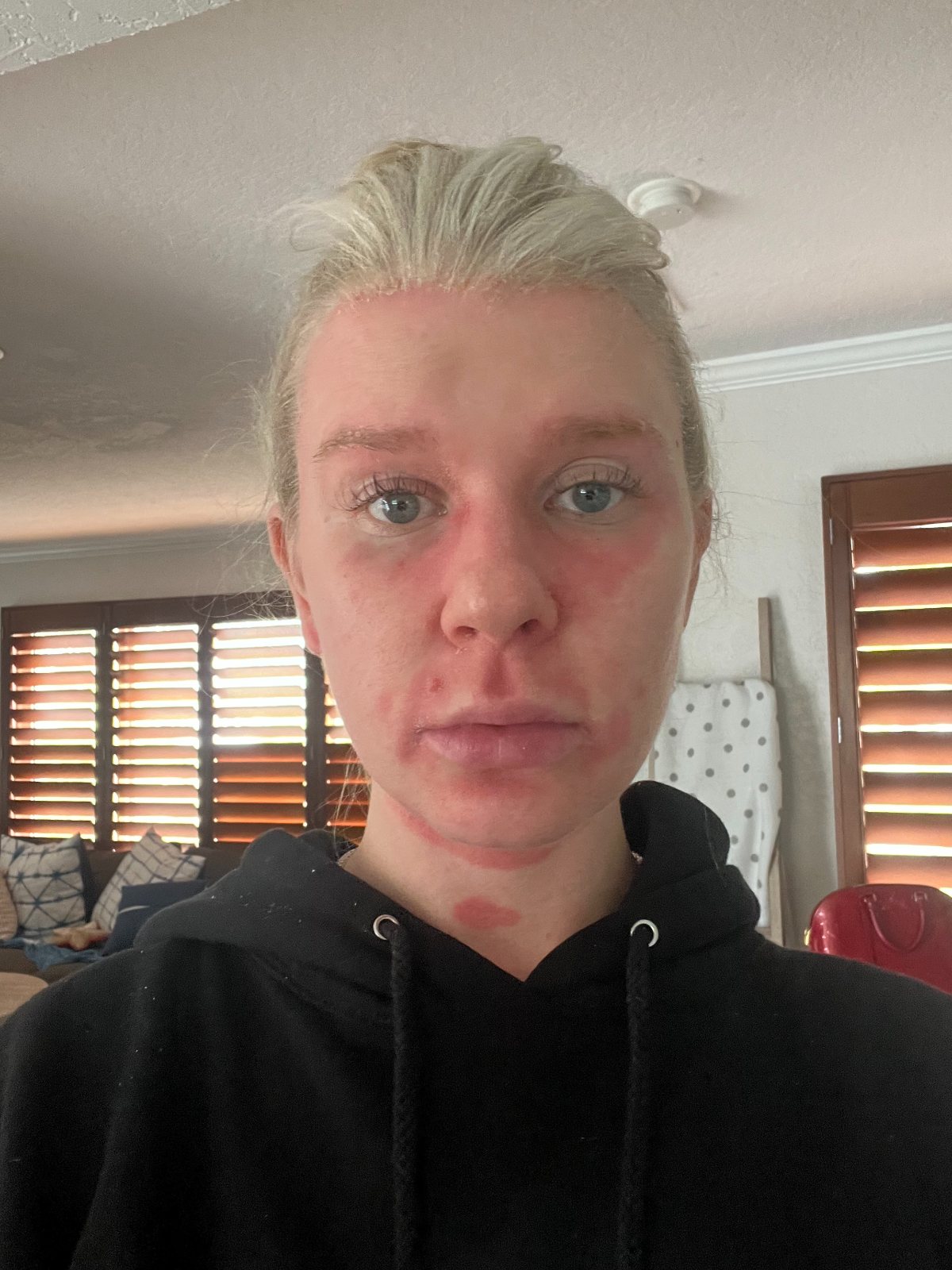 In the thick of it · the hardest stretch (share only what feels right)
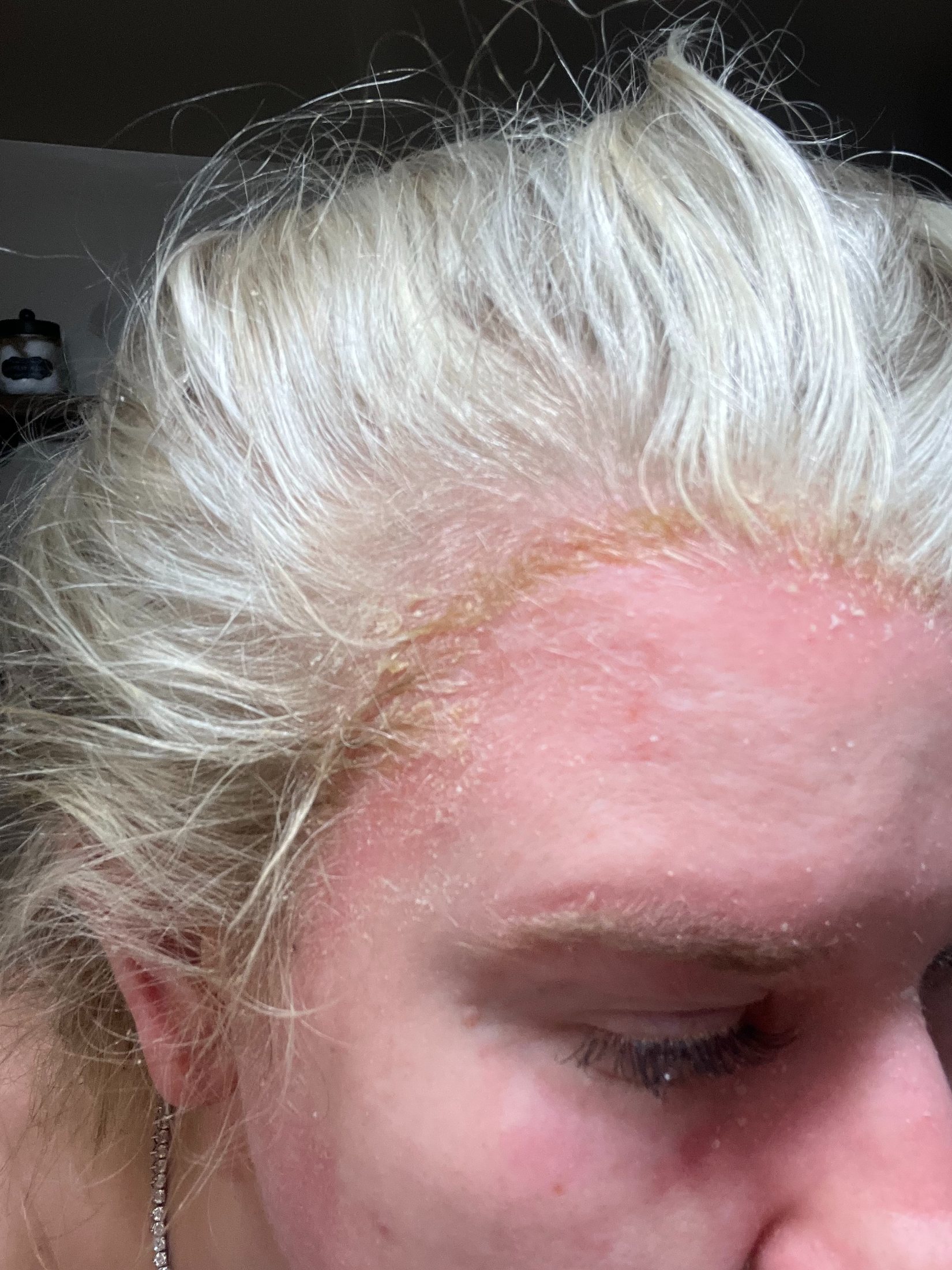
Summer 2023 · the worst of it. June and July were the months I mostly kept off camera — these photos exist only because I made myself document the flares.
The part no one sees
I quit in May 2023, and June through August were the hardest months of my life. Everything the cream had been holding back came at once, worse than the original spot ever was. My eyes would swell. My skin burned and wept like a burn. The flaking was so extreme I had to stop wearing black — I was shedding that much skin, that constantly. Every morning I'd wake up to a pile of dried, flaked skin on my pillow and scattered through my sheets. Along my forehead and hairline, where the skin cracked and oozed, I lost hair that would have to grow back in later. And my confidence went with it. I stopped taking photos of myself; the only pictures of me from those months are the ones I forced myself to take to document the flares. I bought high-necked sweatshirts to cover my neck, started wearing silk scarves, cut bangs to hide my forehead. I couldn't even wear makeup, because makeup made it flare worse. There is a special kind of grief in working in beauty — in being the person people come to so they can feel beautiful — while your own skin is doing everything in these photos.
I cried thinking this was my life forever — a woman who hid her face, who didn't want a single picture taken of her, who missed her old skin.
I still had to work, so I worked. I told my existing clients the truth about what I was going through, and I quietly stopped taking new clients when I could help it — being that vulnerable with a stranger, every single day, was more than I had in me. What kept me going was the community I found the same night I found the documentary: I joined every TSW Facebook group I could and read other people's timelines like maps out. Because the doctors were not it. When I looked for medical help, I was told TSW isn't real — that this was a bacterial infection, that I should take oral steroids, that I should try a different steroid cream. The thing that did this to me kept being offered back to me as the cure. That experience still shapes how carefully I vet anyone who touches my skin — and it's why my advice is never just "see a dermatologist," but find one who takes you seriously.
Finding what actually helped
I tried everything you can imagine. A complete body detox — no sugar, no alcohol, no processed food, a clean Mediterranean diet. Colloidal silver spray several times a day. Chinese herbs, sea moss, bee pollen, every mushroom supplement under the sun, and a supplement list (and spend) that went on and on. Some of it may have helped at the margins. A lot of it just cost money. What genuinely moved the needle for me was simpler and harder: the no-moisture approach I learned about in the TSW community — keeping my skin dry, not washing my face, salt water — plus clean eating, and gentle, non-stripping scalp treatments. And I want to be careful here: this is what helped my skin, on my timeline. These approaches are debated even within the TSW community, and I would never hand anyone my routine as a prescription. What I'll hand you instead is the pattern: gentler turned out to be the answer to almost everything.
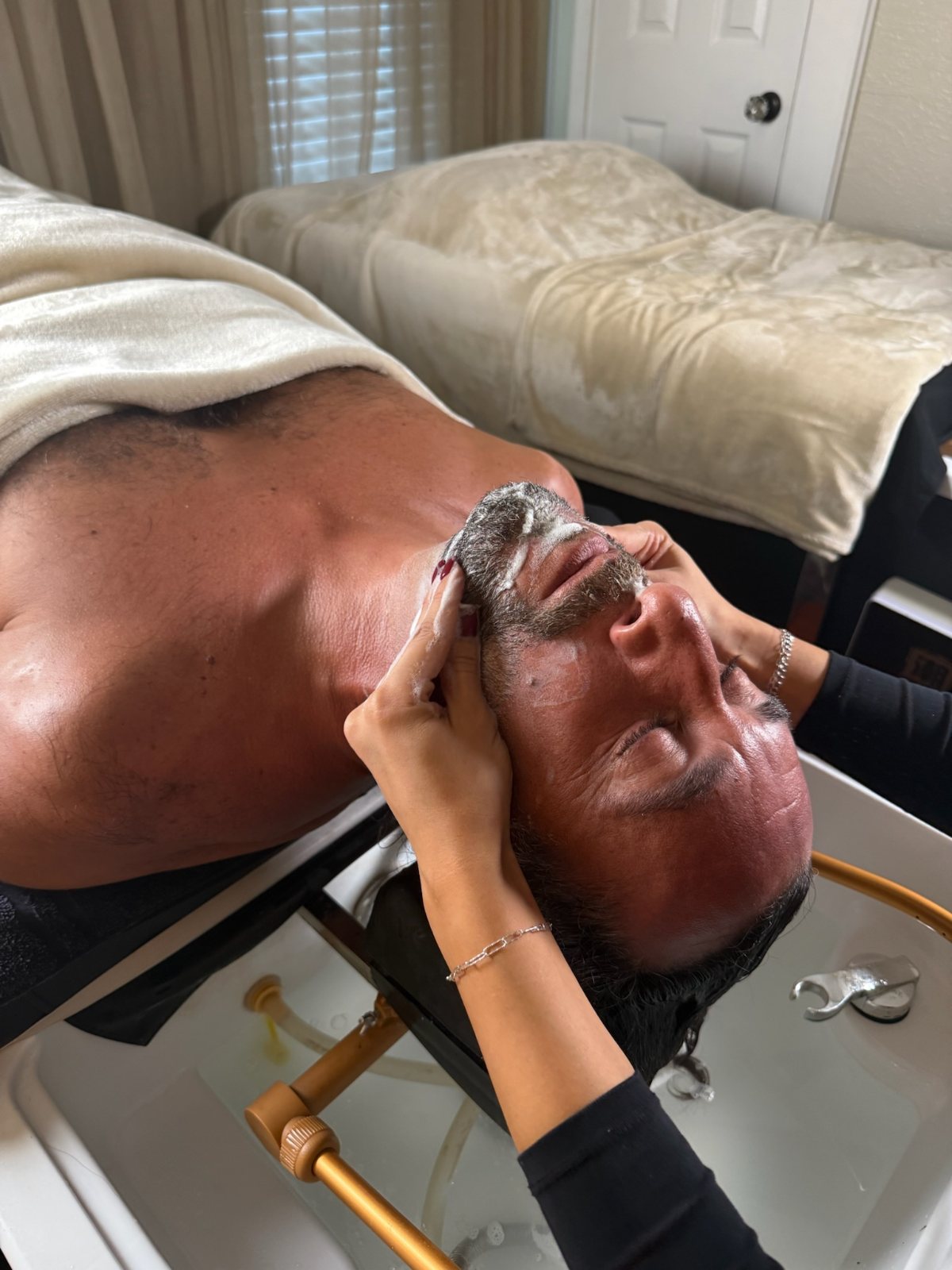
And here's the strange detail that started everything: the treatments that helped most were ones I had to receive in the worst possible setting. During recovery, I was getting those scalp treatments from a true expert in the industry — at a vegan salon, leaned back into a standard, uncomfortable wash-bowl sink, on a salon-floor schedule. The care was right. The room was wrong. Every visit I'd think: this deserves a better place to happen.
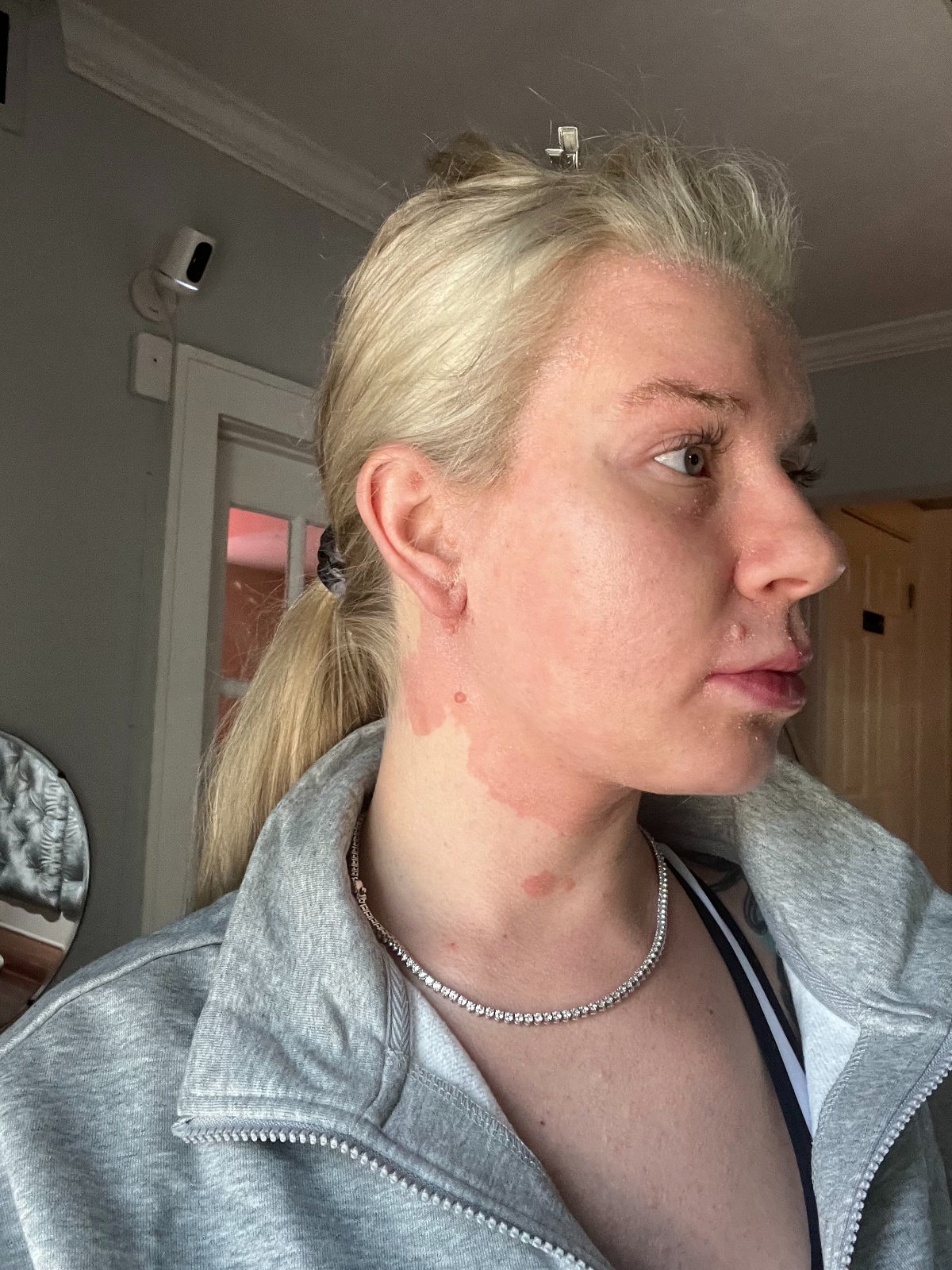 Healing · skin calming, turning the corner
Turning the corner · the deep red fading to patches — the first proof it wouldn't be forever.
Why I built the head spa
When the Japanese head spa movement started quietly arriving in the U.S., something clicked. I had lived the reason for it. I knew exactly what was missing from how scalp care was being delivered — not the technique, but the experience of receiving it. The calm. The dim light. The feeling of being genuinely cared for instead of processed.
So I didn't retrofit a corner of a salon. I built the suites around the ritual — the tables, the lighting, the water, the products — all of it shaped by what I wished had existed when I was the one in the chair, raw and exhausted and just wanting to feel human again. And the scalp therapist from those recovery appointments became a close friend and mentor — and helped me build The Bronze Lily's head spa from the ground up: sourcing the products, creating our treatment protocols, training our team, even working alongside us for a time. The person who cared for me at my worst helped me build the place where we care for you.
 Today · where your skin and you are now
Today · healed, at home in my own skin — in the studio this whole journey built.
Where I am now
Today my skin is amazing — zero flares. My hairline grew back in. I wear makeup again, as much as I want. I get facials again, I use facial products again, I enjoy dessert and a glass of wine again — all the ordinary things TSW took away, handed back one at a time. It wasn't fast and it wasn't a straight line, but I got my skin back. And I got something else too: The Bronze Lily's whole standard of care came out of those two years. It's why our head spa uses European, biodynamic, vegan hair care — clean, natural formulas with naturally harvested ingredients and none of the harsh chemicals my skin taught me to fear — and why every room is built for people who want to feel human again. When you've had skin that couldn't tolerate anything, you build a studio that never asks it to. I wouldn't wish this journey on anyone. I also wouldn't be who I am, or run the studio I run, without it.
If you're in it right now: I see you. It got better for me, slowly and not in a straight line. Be gentle with your skin and gentler with yourself — and lean on a dermatologist who takes you seriously. If my photos make even one person feel less alone in this, then sharing them was worth every bit of the nerves it took.
Resources for topical steroid withdrawal and eczema, including support and provider information, are available through the National Eczema Association (nationaleczema.org). This article reflects one person's experience and is not medical advice.