Right after "does it hurt?" (it doesn't — there's no needle, just a tiny spark weld), the question we hear most at the table is some version of: "Is this going to turn my wrist green in a month?" It's a fair thing to ask. Most people have owned a cheap gold piece that tarnished, flaked, or left a green mark — and they assume all affordable jewelry is the same. It isn't. The word that makes all the difference is filled.
Let me explain it the way I do at the table, because once you understand the three kinds of "gold," you'll never worry about this again — and you'll know exactly why we made the choice we did.
Gold-plated vs gold-filled vs solid gold
There are really three tiers, and they're worlds apart:
- Gold-plated: a microscopically thin layer of gold — often just a few millionths of an inch — electroplated onto a base metal. It's the cheap stuff. That thin film wears through with daily friction, sweat, and water, which is exactly why plated jewelry tarnishes, flakes, and eventually turns skin green as the base metal underneath gets exposed. Usually within months.
- Gold-filled: a thick layer of real 14k gold mechanically bonded to a brass core with heat and pressure. By U.S. law it must be at least 1/20 — 5% — of the item's total weight in solid gold. That layer is roughly 100 times thicker than plating. There's no thin film to wear through, so it doesn't flake or tarnish under normal wear and lasts for years, often decades.
- Solid gold: gold all the way through (14k, 18k, etc.). Beautiful and permanent — and expensive. A single solid-gold welded bracelet often runs $200 to $400 or more.
Gold-filled isn't "fake gold." The entire surface you see and touch is real 14k gold — just bonded to a core instead of solid all the way through.
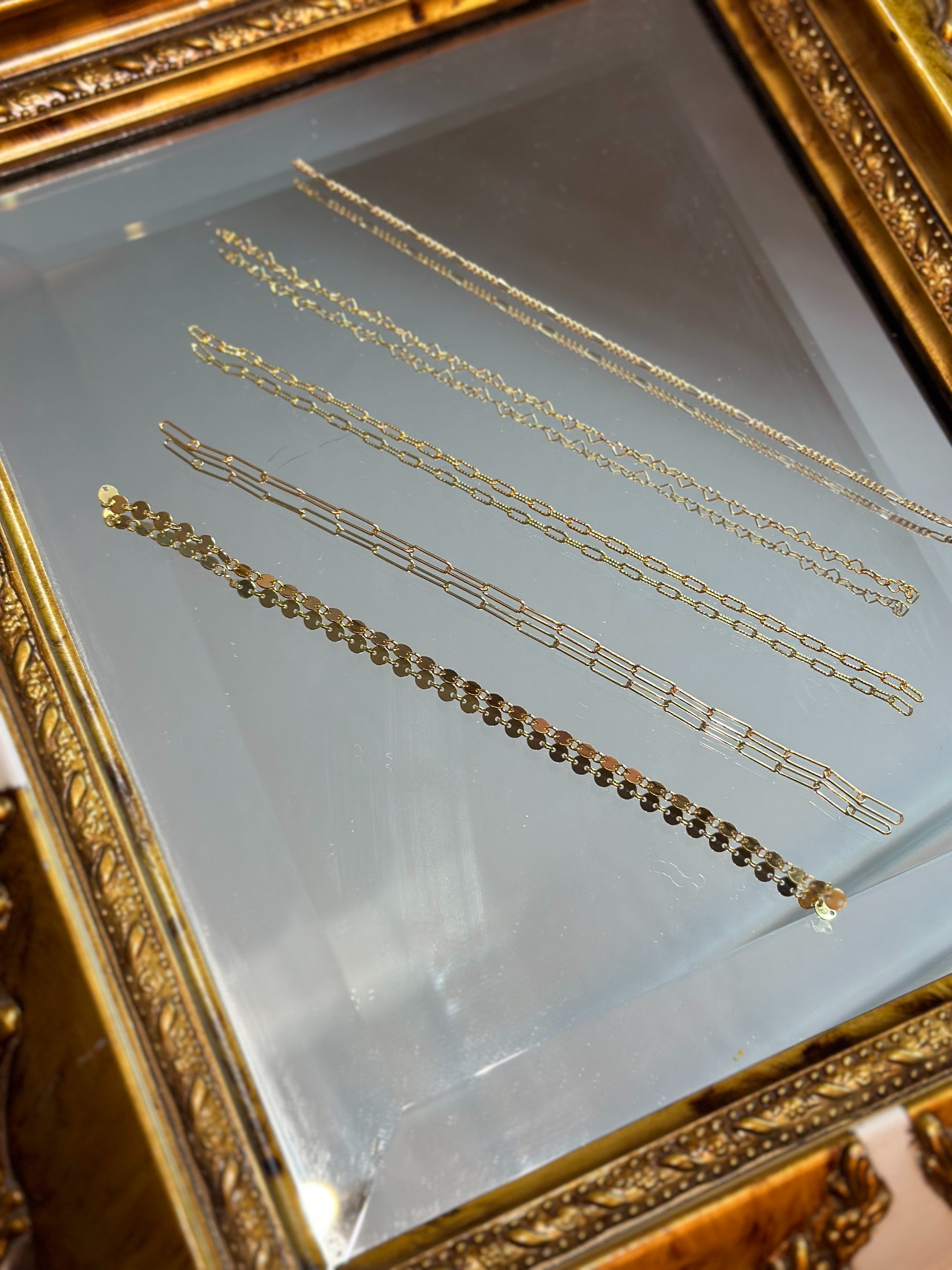 Gold-filled chain detail · warm, real-gold finish
14k gold-filled — a thick, bonded layer of real gold, not a coating.
So will it tarnish or flake?
Under everyday wear, no. Because gold-filled keeps a substantial layer of real 14k gold on every surface, there's no thin coating to crack, peel, or rub off. Our clients shower in it, swim in it, work out in it, and sleep in it — that's the whole point of permanent jewelry. It's built to live on your body.
The honest caveat, because we'd rather tell you than have you find out: prolonged hot-tub and chlorine-pool exposure, over time, can gradually lighten the gold-filled finish (and dull sterling silver). A one-off vacation in the pool is completely fine. It's daily chlorine soaking, repeated for months, that you want to avoid. That's true of essentially all fine jewelry — chlorine is hard on metals — and it's the only real "rule."
Will it turn my skin green?
Not under normal wear. The green mark people remember comes from plated or base-metal jewelry, where the coating wears through to the copper or nickel underneath and reacts with your skin. With gold-filled, that thick real-gold layer stays between your skin and the core, so there's nothing to react. Same with our 925 sterling silver — it's real silver, not a coated base metal. If you've had skin reactions to cheap jewelry before, this is a different category entirely.
Why we carry only 14k gold-filled (and sterling) — not solid gold
This is a deliberate choice, and it comes down to what we want permanent jewelry to be. A welded bracelet isn't really about the metal — it's about marking a moment: a friendship, a milestone, a trip, a memory you want to carry. We never wanted the price tag to be the thing standing between someone and that moment.
Solid gold is gorgeous, but at $200 to $400+ a bracelet, it turns a spontaneous "let's all get one" into a budget decision. Cheap plating is affordable but it's a letdown — it fades and flakes and feels disposable, which is the opposite of what this is supposed to mean. 14k gold-filled is the sweet spot: a real-gold piece that genuinely lasts, at a price (bracelets from $60) that lets a whole group say yes together. That's the point.
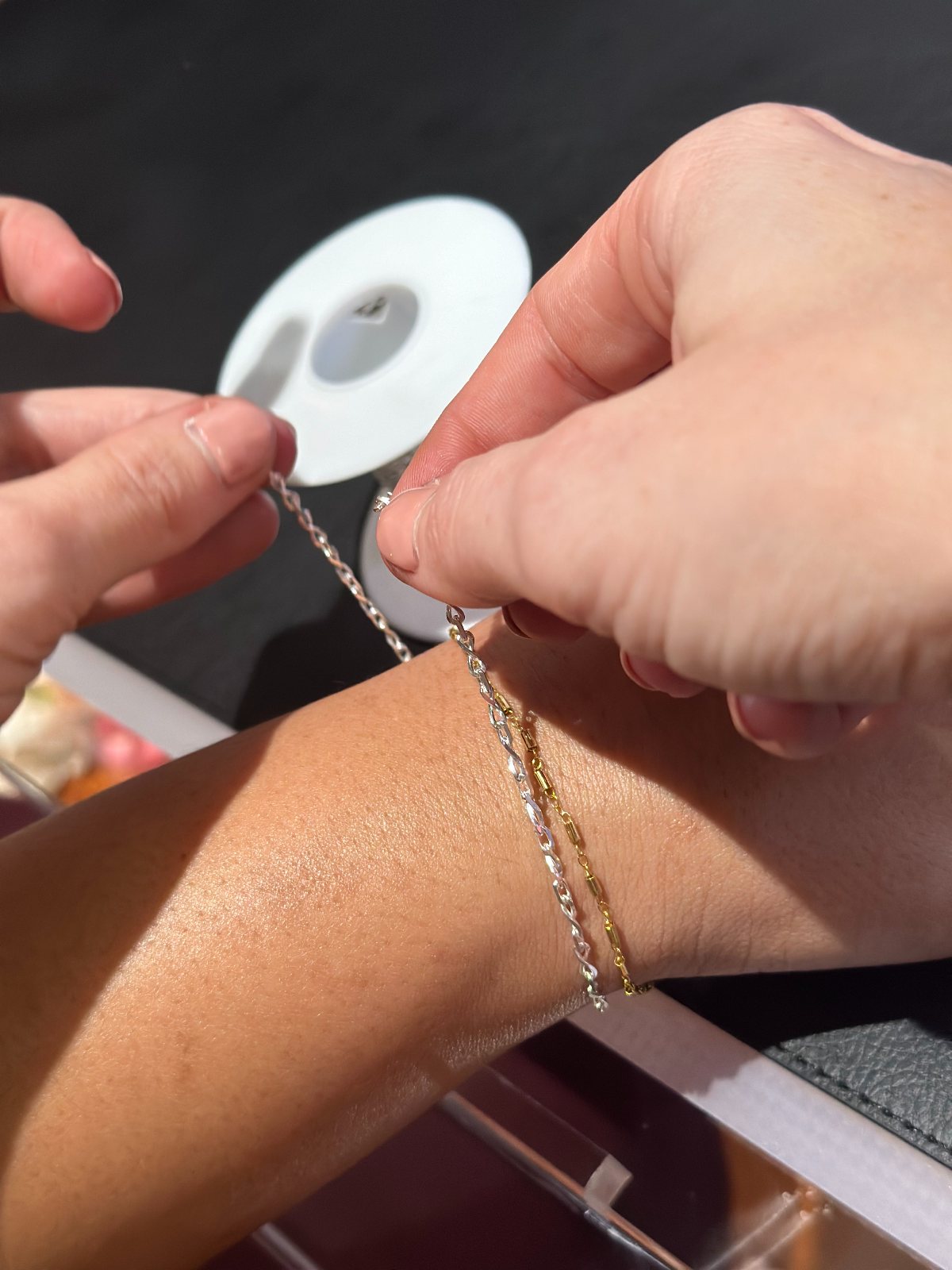 Welding moment · the spark weld at the wrist
How to keep it looking new
Gold-filled and sterling are low-maintenance by design, but a few easy habits keep them bright:
- Live in it. Showering and normal swimming are fine — water won't hurt it.
- Go easy on hot tubs and chlorine pools over the long haul. Occasional is fine; daily soaking over months is what dulls the finish.
- Rinse and pat dry after heavy sweat, sunscreen, or salt water — not required, just nice.
- A soft polishing cloth brings back shine on sterling if it ever dulls. Gold-filled rarely needs anything.
- Lotions and perfumes won't damage it; just let them dry before bed so they don't build up on the chain.
The quick price reference
For the record, here's where we land — real metal, honest prices: 14k gold-filled bracelet $60, anklet $75, ring $20, necklace from $85, hand chain $120. 925 sterling silver bracelet $55, anklet $70, ring $15, necklace from $80, hand chain $100. Custom body chains are designed with you and quoted at the table. (Full menu and how it works →)
So when someone asks me "will this tarnish?" — the real answer is that we chose our metals specifically so the answer could be no. You get real gold or real silver, made to live on your body, at a price that lets you mark the moment. That's permanent jewelry done the way it should be.